

Pennsylvania's Legislative Dysfunction Is Not Just Embarrassing - It's Hurting The Commonwealth And Our Democracy And Costing Us Billions
Let Us Count The Many Ways Our Legislature Is Failing Its Responsibilities to Its Constituents

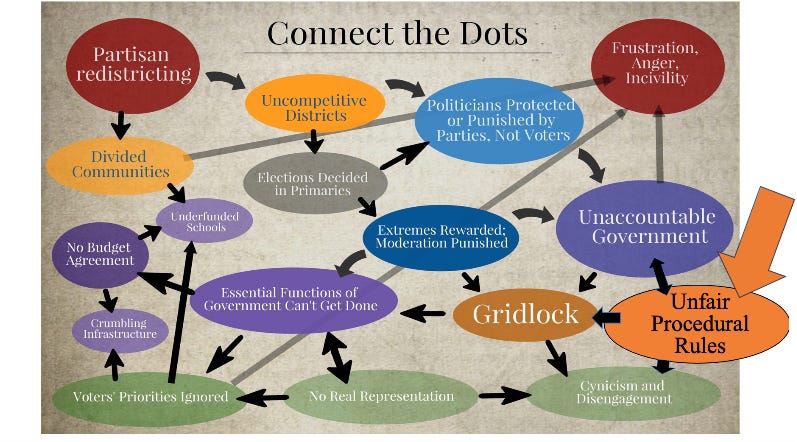
This is the first of a two part post. In this first installment, we examine the systemic waste and dysfunction baked into our legislative process and mounting lack of responsiveness to the needs of the state and its voters.
In the second, coming tomorrow, we will explain that over a decade and a half ago, many of these problems were spotlighted as part of a state grand jury investigation into legislative corruption and self dealing. The grand jury linked the problems to an unaccountable party caucus structure that (surprise?) continues to this day and has never been addressed. And we’ll tell you WHY nothing ever happened and will likely continue NOT to happen ad nauseum in the years ahead.
While this post concentrates on the massive roadblocks Pennsylvania’s legislative process creates to harm effective governance, many of the items we will cite here are also in evidence in legislatures across the country…not least of them the hyper-partisanship and cynicism they breed.
As we have warned, that cynicism is plainly corrosive to to the concept of democratic government. Wherever you live, it is important to push back and demand changes that assure truly representative governance.
For years, Pennsylvanians have watched critical issues linger unresolved while the state legislature in Harrisburg remains trapped in gridlock, procedural maneuvering, and partisan “control.” Advocates for systemic reforms in the rules and procedures of the legislature argue that this dysfunction is not accidental, but structural. They concentrate power in the hands of a few leaders while silencing rank-and-file lawmakers and blocking bipartisan solutions. Reports issued by the nonpartisan reform campaign Fix Harrisburg portray a General Assembly that is among the least effective in the nation, despite being one of the country’s largest and best paid “full-time” legislatures.
When “Representative Government” Isn’t….
At the heart of the problem is a system in which party leaders and the committee chairs they select exert extraordinary control over which bills receive hearings or votes. According to Fix Harrisburg (a spin-off of parent reform group Fair Districts PA, of which I am a member) “one committee chair or one legislative leader can block a bill that has strong, bipartisan public support.” This means legislation supported by lawmakers from both parties — and often by large majorities of voters — can simply disappear without meaningful debate - blocked by an individual leader representing less than a half-percent of the state’s voting population.
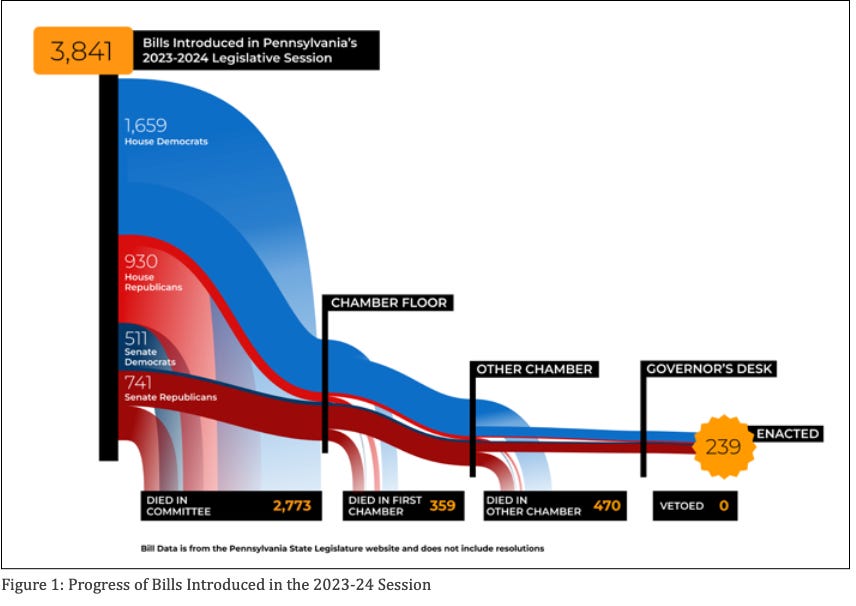
Fix Harrisburg reports that in recent legislative sessions, less than one in five bills introduced was even considered in committee.
Fewer than half the bills passed by one chamber were considered by the other chamber
Fewer than 7% of all introduced bills ever reached a final vote.
For a legislature that supposedly operates year-round and armed with substantial taxpayer funding, those statistics suggest systemic paralysis rather than productive governance.
The 2025-26 Legislature’s Report Card to Date
The following data was compiled by a volunteer with Fair Districts PA who has become an expert in researching our legislature’s operations and costs and documenting its mounting disarray. Over the past decade she has spent a substantial portion of her time wading through videos of legislative and committee proceedings and mountains of documents on debates and votes - or lack of them. Here is what she has documented for the current session:
We are 18 months into the “2-yr” session (78% in) (actually just 23 months long); 5 months remain...
As of July 4th, according to the PA General Assembly Website:
3,897 bills introduced
2,791 still in committee, 72% !! (totaled by looking at each of the 48 committees’ webpages)
1,106 voted out of committee, 28%
99 of the 1,106 bills (9%) have been enacted.
20 of the 99 are appropriations bills and are related to budgets.
The House and Senate have each currently scheduled just 11 voting session days in the remaining 5 months, through the end of the “2-yr” session, Nov 30, 2026.
As of July 4th, the next scheduled session day is not until Sep 28th. (They will likely add more to enact a budget, but I doubt there will be much bill/committee business beyond the budget)
Once the session ends Nov 30th, all bills not enacted will no longer exist.
Action by 26 House Committees:
2,570 bills introduced
797 voted out of committee
1,773 still in committee, 69%
22 Senate Committees:
1,327 bills introduced
309 voted out of committee
1,018 still in committee, 77%
The committee count does not include Ethics, Rules, nor Government Oversight Committees as they do not have bills referred to them.
This dysfunction our research expert details here has real-world consequences. Pennsylvania faces serious long-term challenges involving infrastructure, transportation, school funding, property taxes, healthcare access, broadband expansion, ethics reform, and economic competitiveness. Worse yet, its failure to create an equitable tax structure leaves it continually short of funding come budget time. Meanwhile many bipartisan proposals addressing those issues repeatedly die in committee or are never scheduled for votes..session after session.
Funding Pennsylvania Education
Education provides one of the clearest examples of the damages of legislative dysfunction. In 2023, a Pennsylvania court ruled that the state’s public-school funding system was unconstitutional because it produced massive disparities between wealthy and poor districts. Yet despite widespread recognition of the problem, comprehensive reform since that ruling has moved slowly through Harrisburg’s legislative machinery.
Three years after that decision however, the state is struggling to address the shortfall due to its highly regressive tax structure and budget shortfalls - ones caused by Covid and massive cuts in federal funding for states under the Trump administration. The result is continuing inequality for students in poorer districts, many of whom lack the educational resources available in wealthier communities.
Crafting State Budgets In a Divided Legislature
Our current stalled budget negotiations provide another window into the legislature’s procedural problems. Fix Harrisburg describes a recurring practice known as “gut and replace,” in which large, complex bills are stripped of their original contents and replaced with entirely new language at the last minute. Legislators are then asked to vote within hours on hundreds of pages they have had little or no time to read.
Such practices undermine transparency, weaken public oversight, and reduce most of our 50 Senators and 203 Representatives to the role of spectators in decisions involving billions of dollars.
The Dangerous Growth of Public Cynicism
Citizens reasonably expect legislators to debate proposals openly and carefully. Instead, many important decisions occur behind closed doors among a handful of leaders. When ordinary legislators have little influence, voters naturally feel their own voices matter less as well.
The dysfunction becomes even more severe during periods of divided government. The Pennsylvania House and Senate have increasingly operated under razor-thin partisan margins, making compromise both more necessary and more difficult. It was one of the key reasons why they couldn’t agree on an annual budget until October of 2025. Our constitution sets the deadline at June 30th.
During budget season very little else gets done. Leaders hold other legislation, some of it purposely, as bargaining chips. Rank and file legislators simply wait to learn what leaders have decided when they first get a glimpse of the proposed figures.
Fix Harrisburg’s report Is Gridlock Inevitable? argues that divided government alone does not explain Pennsylvania’s poor performance. Other states with divided control pass far more legislation and operate more efficiently.
Take a look at the massive output from Harrisburg THIS session in comparison to our neighbors (NOTE these are figures as of the beginning of last month):
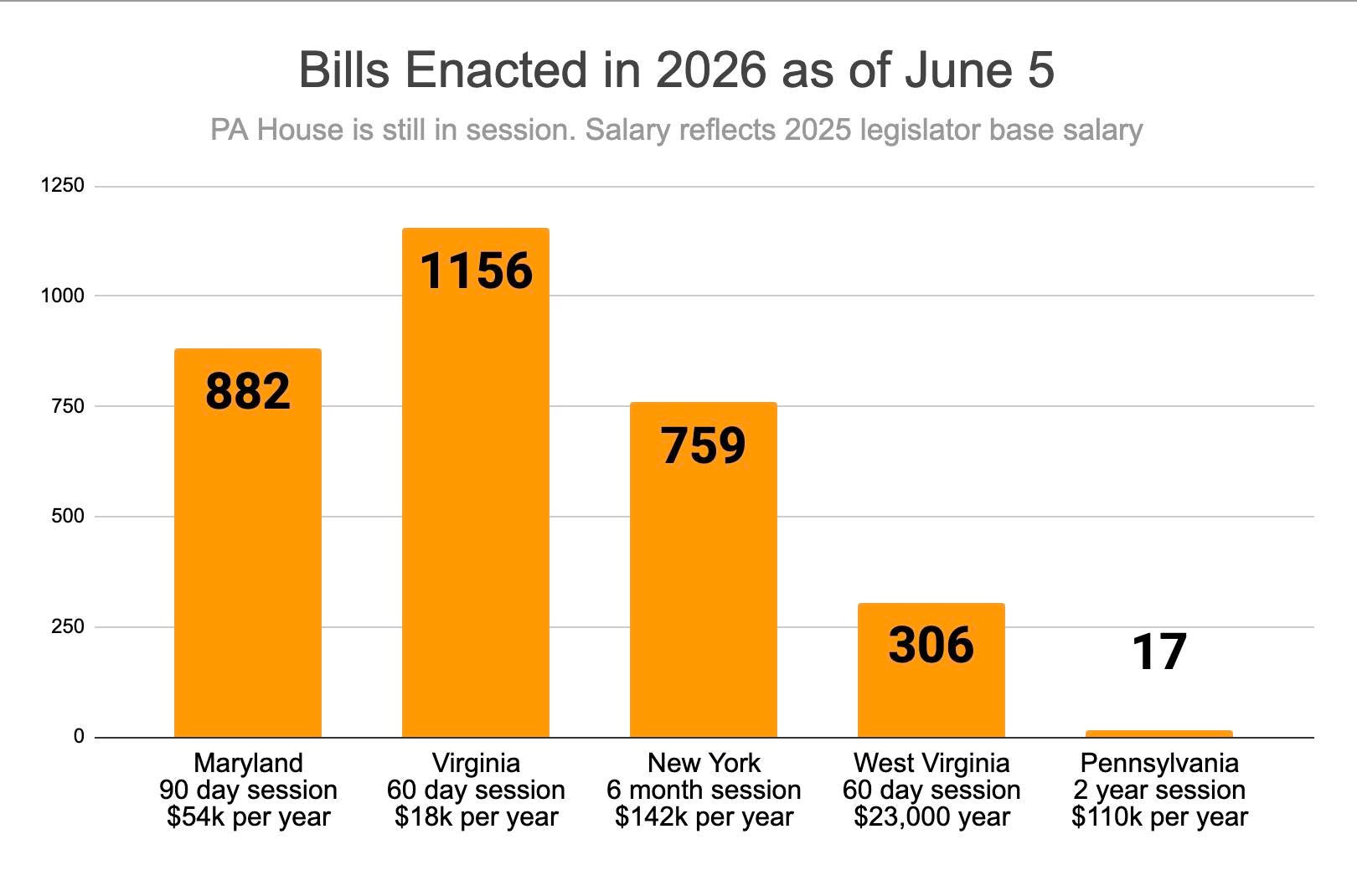
That comparison is especially troubling because Pennsylvania has among the largest full-time legislatures in the United States and pays its legislators more than most states. The fixed costs to PA taxpayers for all of this are both astounding and maddening.
Sitting On A Massive Surplus
In looking closely at what all this costs us, our intrepid researcher also came up with these figures:
Last budget year operating the legislature cost the taxpayers more than $463M as documented in their annual audit. This includes the support agencies required for their “work”.
The current budget year ended June 30th. The last published monthly PA Budget Office report for May showed legislative expenses to that point were $431 million. That means we are on a path to spending nearly a half-billion dollars this budget year for the legislature alone. ($470M).
Put a different way – that’s $1,300,000 a day, 365 days a year
Worse yet, the data shows that $250M of the $431M expended flow from just four line items: The Republican and Democratic caucuses in the House and Senate. Nearly 60% of what they spend hides behind the “Caucus” curtain. No transparency. No accountability. Even their flimsy annual audit just uses those four line items. (NOTE: Our post tomorrow will dig into a state grand jury report that called this problem out over a decade and a half ago and why nothing substantive has changed since then.)
And, when they wrote the Sunshine Law, that same Legislature excluded their caucuses from having to provide details of those massive expenditures!!
Every Day is a “Rainy Day” in Harrisburg
Want some more outrage?
All Pennsylvania agencies must return any unexpended funds from their budget year to the General Fund….with one exception…..the Legislature. Instead, unexpended Legislative funds, our taxpayer dollars, go into a cumulative “reserve” controlled by legislative leaders.
The size of THAT fund is now approaching $400M, while the state struggles to fund infrastructure, schools, public transportation, emergency services and healthcare.
Legislators call it a “Rainy Day Fund” to handle times of challenge, but when the challenges are standing right in front of them, they argue it would be irresponsible to dip into the fund.
In the meantime reform groups argue the public receives little return on that investment because procedural rules allow obstruction to dominate governance.
Political Polarization and Gridlock
One of the most damaging outcomes of this dysfunction is political polarization. Research nationally shows that modern legislatures increasingly reward partisan loyalty over collaboration. In Pennsylvania, procedural rules magnify those tendencies by centralizing authority in leadership offices and committee chairs who are appointed by and loyal to legislative leaders.
Rather than encouraging broad coalition-building, the system rewards leaders who tightly control agendas and prevent politically risky votes.
The effects ripple far beyond Harrisburg.
Businesses seeking predictability face uncertainty when infrastructure investments, tax reforms, or economic-development policies stall indefinitely.
School districts struggle to plan long-term budgets.
Municipal governments wait months for state appropriations.
Public transit agencies, healthcare providers, and social-service organizations face funding instability caused by delayed state budgets and legislative stalemates - all of it made worse by massive cuts in federal aid to states.
Fighting for Change
Fix Harrisburg, FDPA and allied reform groups argue that solutions do exist.
They advocate rules changes that would make it easier for bills with bipartisan support to receive committee hearings and floor votes, reduce leadership bottlenecks, and improve transparency in the legislative process.
They also support reforms that would strengthen public participation and reduce the ability of party leadership to dominate decision-making.
Pennsylvania’s “Inalienable Right to Alter and Reform” is a Lie
The debate ultimately raises a deeper question about representative government itself and one we focused on in a previous post. Pennsylvania’s Constitution declares that “all power is inherent in the people” and that citizens possess the right to “alter, reform or abolish” government when necessary. Yet many reform advocates believe the legislature’s current structure, its legislative rules and other obstacles prevent lawmakers from fully representing the people who elected them.
It also makes it nearly impossible for PA citizens to exercise that claimed Constitutional right if the measure at question is opposed by legislative leaders. And it gives inordinate power to wealthy outside interests.
There is no ban on gifts to legislators, giving powerful interests the ability to funnel large contributions, primarily to the legislative leaders, who in turn control the legislative agenda. That is one reason why bills with popular support…bills that might threaten those same powerful interests, repeatedly die in committee.
It is also why our legislature loves to dole out massive tax breaks to those same interests. One glowing example….$1.6 billion to Shell to encourage construction of a giant facility south of Pittsburgh to turn carbon energy into plastic pellets. The plant has been plagued ever since with problems, often releasing more pollution in a month than it’s regulated annual limit. Shell is now looking to sell it.
Despite a deeply regressive tax system that leans heavily on property and sales taxes, the legislature refused to impose any energy extraction tax on fossil fuels. We are one of the few states with major fossil fuel resources to fail to do so. Meanwhile the companies themselves have reaped billions in profits while we can’t find the funds to support important public programs.
The industry has left PA with a legacy of what some experts say could be hundreds of thousands of old wells…many uncapped and most leaking dangerous methane.
The state and federal government wind up trying to rectify the problems with funds that could be providing better schools, infrastructures, healthcare and services.
As we just noted in a recent post, a new State Supreme Court ruling could open up a substantial and badly needed revenue stream from regulation of so-called skills games. The challenge is whether a legislature divided on the issue across party lines AND within parties, can enact legislation to capture that stream.
The state has no petition and referendum process that would allow citizens to gather signatures on to force consideration of bills over leadership opposition.
Discharge petitions (gathering enough legislator signatures to force bills out of committee and onto the floor) have been tried nearly four dozen times over the past decade and never succeeded.
While our “full-time” state legislature is one of the few in the country with two-year sessions, it actually holds voting sessions in Harrisburg at an astoundingly limited pace. From the Is Gridlock Inevitable report:
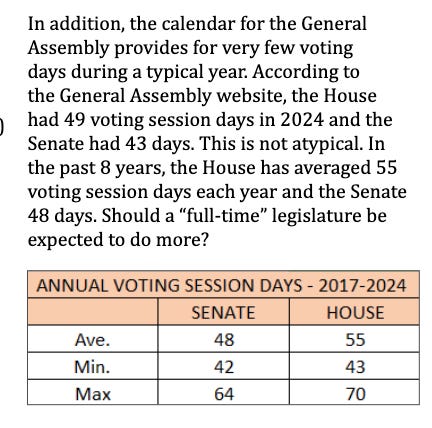
Things are even worse this session:
Session will end Nov 30.
The House has scheduled 17 voting session days;
The Senate has scheduled 18.
Neither are scheduled to meet at all in July or Aug and just twice in Nov, the month before session adjournment.
Our Legislature Is Designed to Obstruct
Pennsylvania is not suffering from a lack of ideas or public engagement. It is suffering from institutional rules that reward obstruction, centralize power, and suppress debate. Until those structural problems are addressed, the Commonwealth will continue to experience a legislature that consumes enormous resources while delivering too little progress for the people it serves.
Given the impediments to real change and the lack of resources to force action by legislators, Pennsylvania voters’ only real recourse is to demand each of their legislators represent them by taking up reforms, debating and enacting them. Without those changes we will continue to lag our neighbors and the nation as a whole.
WHAT YOU CAN DO!!!
If you are a PA citizen, visit www.fairdistrictspa.com/take-action to do any or all of the following:
Sign the petition calling on legislators to represent us by debating and voting on House Bill 31 and SB 131 to reform PA redistricting and help end gerrymandering. You will join over 134,000 Pennsylvanians who have already done so.
Get the information you need to contact your state representatives directly and tell them the same thing.
Volunteer - they can match your skills to their needs.
Schedule a Fair Districts speaker for your group or organization.
If you live in another state that also lacks fair districting, let your legislators know you want independent redistricting. Tell them you oppose mid-cycle gerrymandering for political advantage, no matter which party is doing it.
As always:
- MAKE SURE YOU ARE REGISTERED TO VOTE IN NOVEMBER
- MAKE SURE FRIENDS, FAMILY AND ASSOCIATES ARE DOING THE SAME
- SUPPORT ORGANIZATIONS THAT ARE FIGHTING TO PROTECT OUR RIGHTS INCLUDING DEMOCRACY DOCKET, THE ACLU, FAIR DISTRICTS PA, THE LEAGUE OF WOMEN VOTERS AND OTHERS.
- SUPPORT GOOD TRADITIONAL AND INDEPENDENT JOURNALISM IN YOUR AREA INCLUDING ORGANIZATIONS LIKE SPOTLIGHT PA AND PUBLIC BROADCASTING.
- DONATE TO CANDIDATES COMMITTED TO DEMOCRACY, THE RULE OF LAW AND OUR CONSTITUTION.
- FIGHT LIKE YOUR DEMOCRACY DEPENDS ON IT….
BECAUSE IT DOES!!!